Why Walking Is the Best Joint Medicine There Is


Vet Reviewed by Dr. Jacob Klos, DVM

National Walk Your Dog Week is the perfect time to understand why daily walking isn't just good for your dog's heart and waistline. It's one of the most powerful things you can do for their joints.
How walking protects joints
Cartilage, the smooth tissue that cushions the ends of bones in a joint, has no blood supply. It receives nutrients and removes waste through a process called imbibition, which depends on movement. When the joint moves, synovial fluid is pumped through the cartilage, delivering nutrients and carrying away waste products.
Without regular movement, cartilage becomes malnourished. It thins, dries, and loses its ability to absorb shock. This is why sedentary dogs often develop joint problems faster than active ones, even at the same age.
Walking provides the gentle, repetitive joint loading that drives this nutrient exchange. Every step your dog takes is literally feeding their cartilage.
The muscle-joint connection
Joints don't work in isolation. They're stabilized by the muscles, tendons, and ligaments that surround them. When those muscles are strong, they absorb impact forces that would otherwise load directly onto the joint surfaces.
Walking builds and maintains the muscle strength that protects joints. A dog that walks daily has stronger quadriceps, hamstrings, and core muscles than a sedentary dog, and those stronger muscles mean less stress on the joints with every step, jump, and turn.
Range of motion maintenance
Stiffness doesn't happen overnight. It develops gradually as joints are used less. Walking through a full range of motion (forward stride, rear push-off, natural turning) maintains the flexibility that keeps joints functional.
Dogs that don't walk regularly often show subtle range-of-motion loss before any visible limping appears. By the time stiffness becomes obvious, the loss has been building for months.
How to walk for joint health
Consistency matters more than distance: A 20-minute daily walk is better for joint health than a single 2-hour weekend hike. Joints respond best to regular, moderate use.
Warm up: The first 5 minutes of any walk should be at an easy pace. This allows joints to lubricate and muscles to engage before the pace increases.
Match the walk to the dog: A senior dog with existing joint issues benefits from a slow, steady 15-minute walk on flat ground. A young, healthy dog can handle longer distances and varied terrain. The goal is movement without overload.
Surface matters: Soft surfaces (grass, dirt trails) are easier on joints than hard surfaces (concrete, asphalt). Vary your route to include softer terrain when possible.
Watch for post-walk stiffness: If your dog is stiff or sore after walks, the distance or intensity may be too much. Reduce the length and rebuild gradually.
Walking + nutritional support
Walking provides the mechanical stimulus that keeps joints healthy. Nutritional support provides the building blocks the body needs to maintain and repair joint tissue.
Glucosamine supports cartilage production and maintenance. Chondroitin helps retain moisture in joint fluid for shock absorption. MSM supports connective tissue flexibility. Omega-3 fatty acids support a healthy inflammatory response in active joints.
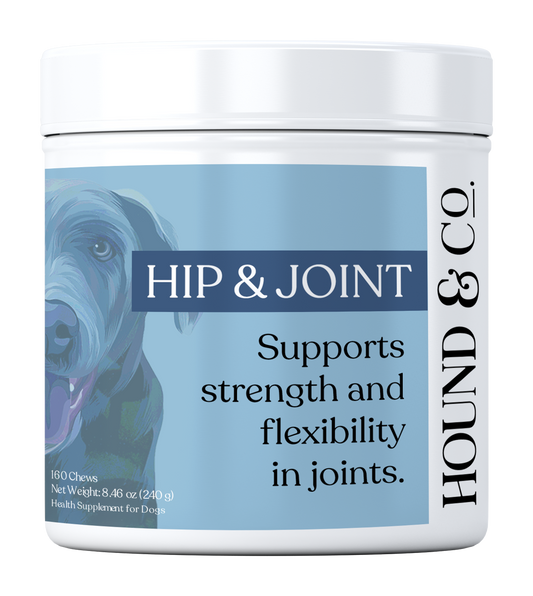
Our Hip & Joint Chews deliver all four in veterinary-strength doses. Combined with a consistent daily walk, they provide the most effective joint health strategy available to dog owners.
[Shop Hip & Joint Chews]
Sources:
- AKC: Exercise and joint health in dogs, walking guidelines
- Veterinary orthopedic literature on synovial fluid dynamics and cartilage nutrition
- Veterinary sports medicine literature on muscle-joint stabilization in canines
- Veterinary nutrition literature on glucosamine/chondroitin supplementation