Why Summer Is the Hardest Season on Joints


Vet Reviewed by Dr. Jacob Klos, DVM

Summer should be the best season for active dogs. And it can be, if the joints can keep up. The problem is that summer activity patterns create a perfect storm of joint stress that most owners don't recognize until the damage is underway.
The activity spike problem
Most dogs are significantly less active during winter and early spring. Then summer arrives, and activity levels spike dramatically: longer hikes, beach runs, swimming, fetch marathons, off-leash play at the park.
This sudden increase in intensity and duration puts enormous stress on joints, tendons, and cartilage that haven't been conditioned for it. It's the canine equivalent of running a marathon without training. The body isn't prepared, and the joints absorb the consequences.
Impact loading increases
Hard surfaces (pavement, packed trails, concrete), jumping (in and out of cars, off docks, over obstacles), and high-speed directional changes (chasing balls, playing with other dogs) all create impact forces that load directly through the joints.
In a well-conditioned dog with healthy cartilage, these forces are absorbed and distributed efficiently. In a dog with early cartilage thinning, reduced joint fluid, or pre-existing joint issues, these same forces accelerate wear.
Heat compounds the problem
High temperatures increase blood flow to the skin for cooling, which can reduce blood flow to deeper tissues including joint structures. Hot pavement and surfaces can cause dogs to alter their gait to avoid discomfort, which changes the biomechanics of how forces travel through the joints.
Dogs also tend to rest more during peak heat, then burst into intense activity during cooler morning and evening hours. These bursts without adequate warm-up are a recipe for soft tissue strain.
The dogs at highest risk
- Large and giant breeds: More body weight means more force through every joint with every step.
- Dogs over age 5: Cartilage naturally thins with age. What was once adequate joint support may no longer be.
- Previously injured dogs: Joints that have been strained, sprained, or surgically repaired are more vulnerable to re-injury during high-activity periods.
- High-drive breeds: Dogs that don't self-regulate (Retrievers, Border Collies, Cattle Dogs) will run until they physically can't. Their enthusiasm exceeds their joints' capacity.
Protecting joints during peak season
- Warm up before intense activity: A 5-minute leash walk before off-leash play or a hike gives joints time to lubricate and muscles time to engage.
- Ramp up gradually: Don't go from minimal winter activity to 3-hour summer hikes overnight. Build distance and intensity over 2 to 3 weeks.
- Provide rest days: Alternate high-activity days with lower-intensity days. Recovery time is when the body repairs and rebuilds.
- Watch for early signs: Stiffness after rest, reluctance to jump, shortened stride, or slower pace on walks are early indicators of joint stress. Don't wait for a limp.
- Support joints daily: Glucosamine supports cartilage maintenance and repair. Chondroitin helps retain moisture in the cartilage for shock absorption. MSM supports connective tissue flexibility. Omega-3 fatty acids support a healthy inflammatory response in joints under stress. These ingredients work cumulatively with consistent daily use.
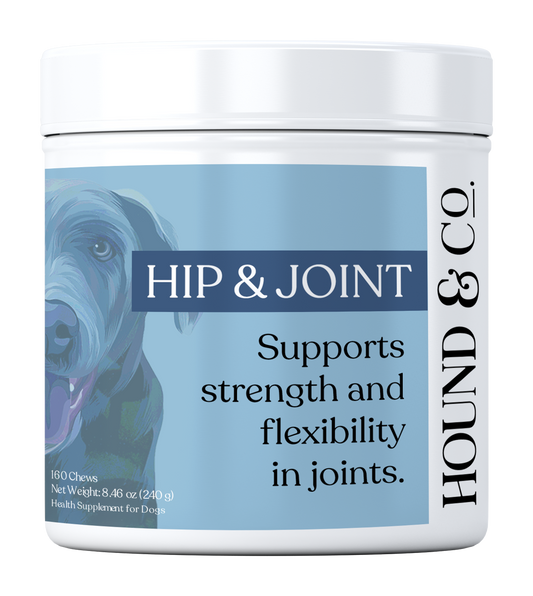
Our Hip & Joint Chews combine all four in veterinary-strength doses, designed for dogs of all sizes, especially those whose summers demand the most from their bodies.